




Automation Intelligence is no longer just about automating repetitive tasks. In 2026, successful Generative AI projects combine reliable data, model evaluation, secure infrastructure, workflow design, governance and business ownership. Teams that connect those capabilities are better positioned to turn AI experiments into dependable products and measurable operational improvements.
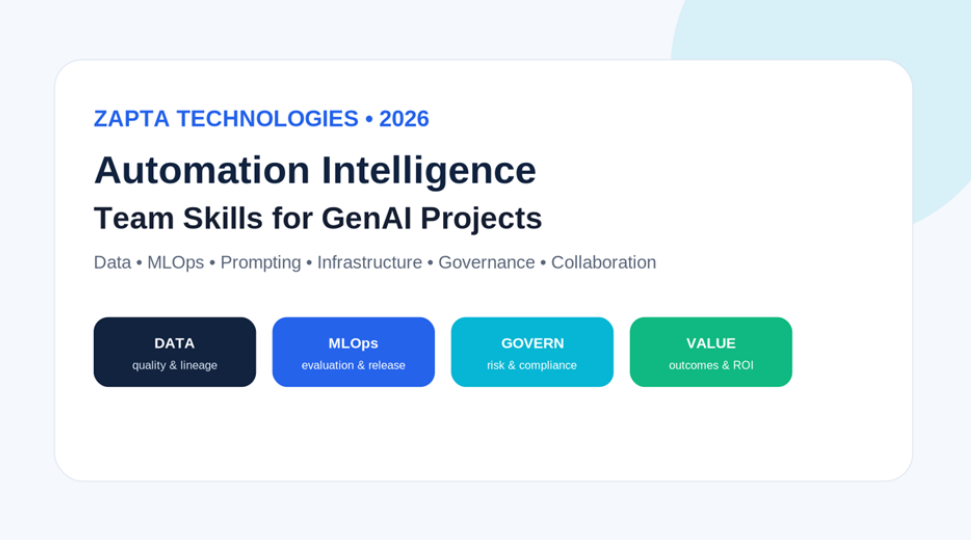
Quick Answer: What skills does a Generative AI project team need in 2026?
- Data engineering: trustworthy pipelines, lineage, access controls and evaluation datasets.
- AI engineering and prompt design: models, retrieval, tools, structured outputs and business context.
- MLOps and evaluation: testing, monitoring, release management and incident response.
- Cloud and infrastructure: APIs, compute, observability, security and usage-based cost control.
- AI governance: privacy, risk, human oversight, documentation and compliance.
- Automation and process design: workflow automation, RPA, integrations and intelligent agents.
- Cross-functional leadership: shared ownership of outcomes, adoption and ROI.
Why Generative AI Management Differs From Traditional Software Development
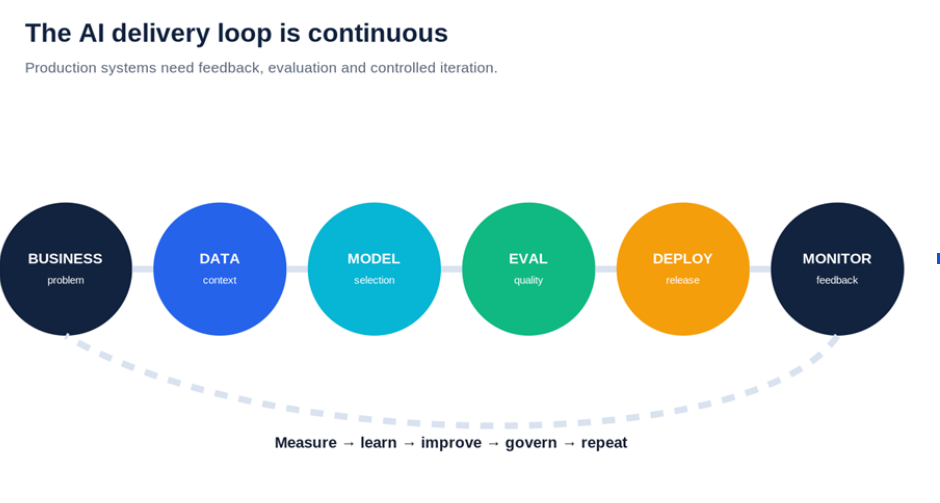
Generative AI requires a continuous management loop rather than a simple build-and-release cycle. AI systems need ongoing evaluation of outputs, data quality, safety, latency, cost and changing business context in addition to conventional software testing.
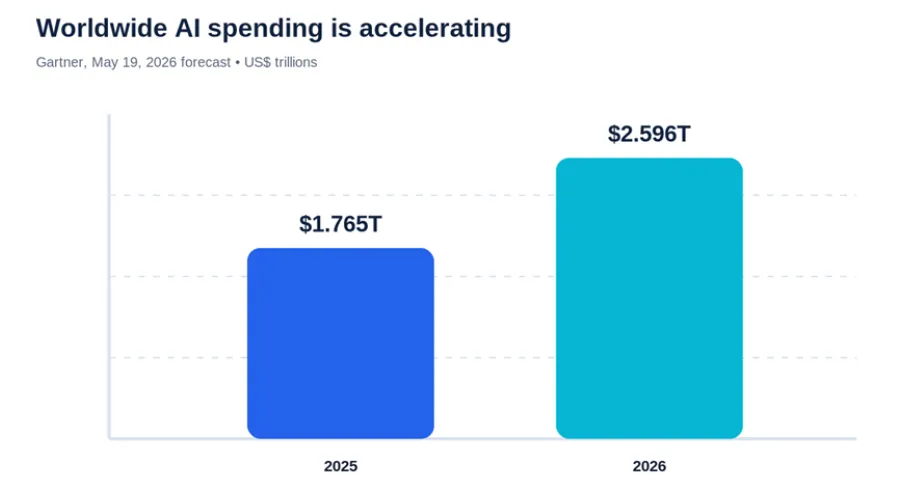
Gartner forecast worldwide AI spending of $2.59 trillion in 2026, up 47% year over year, in its May 19, 2026 forecast. Gartner also projected AI infrastructure to account for more than 45% of AI spending. [Gartner, May 19, 2026]
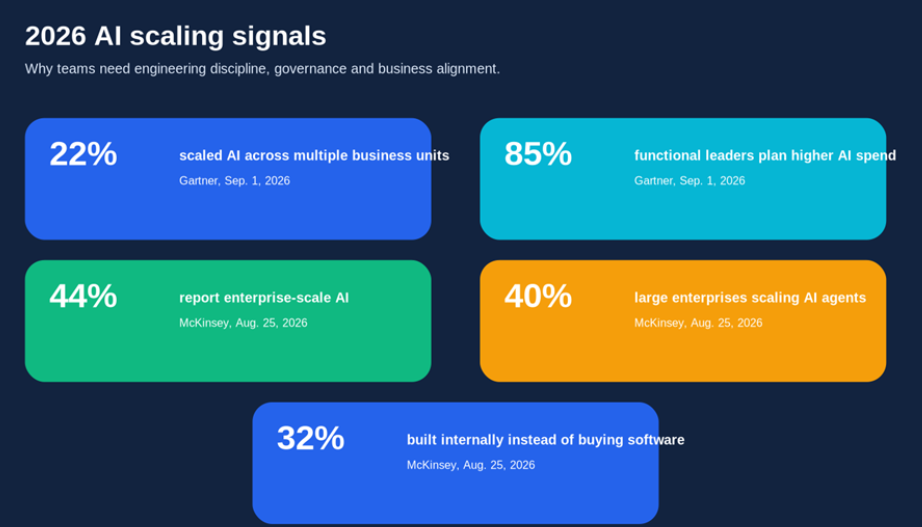
Adoption is moving toward broader deployment, but scaling remains difficult. Gartner reported on September 1, 2026 that only 22% of organizations had successfully scaled AI across multiple business units or adopted an AI-first approach, while 85% of functional leaders planned to increase AI spending in 2026. [Gartner, September 1, 2026]
The Essential Skills for Managing Generative AI and Automation Intelligence Projects
1. Data Engineering and Data Quality
Data engineering is the foundation of reliable AI outputs. Teams need people who can collect, clean, transform, catalog and secure the information that models and automation workflows depend on. This includes data pipelines, metadata, lineage, permissions and evaluation datasets.
For Automation Intelligence, the requirement extends beyond model training. A workflow agent that reads CRM records, ERP data, support tickets or documents must receive the right information under the right permissions. This connects directly to data analytics consulting services, predictive analytics services and predictive insights software.
2. AI Engineering, Prompt Engineering and Domain Expertise
AI engineering turns a capable model into a useful business system. Teams need skills in prompt and context design, retrieval-augmented generation, tool calling, structured outputs, model selection and application-level evaluation.
Prompt engineers and domain experts should work together: technical specialists optimize instructions and evaluation criteria, while subject-matter experts verify that outputs match policies, customer expectations and real operating conditions. Gartner’s June 2026 research highlighted domain-specific models, smaller reasoning models, agentic AI and multimodal capabilities as important directions for GenAI adoption. [Gartner, June 2026]
3. MLOps, LLMOps and Continuous Evaluation
MLOps and LLMOps provide the operational discipline that keeps AI Development systems reliable after launch. Teams need repeatable processes for versioning, testing, deployment, monitoring, rollback and incident response.
For generative systems, evaluation should cover groundedness, relevance, instruction following, safety, latency, failure rates and cost. A strong team establishes a baseline before release and monitors performance as prompts, models, data and workflows change.
4. Infrastructure, Cloud Scalability and AI Cost Management
Infrastructure skills are essential because AI workloads can change cost and performance profiles quickly. Teams should understand cloud architecture, model APIs, compute, caching, observability, security and capacity planning.
Gartner’s July 2026 forecast put worldwide end-user spending on AI models and platforms at $64.25 billion in 2026, up 63.4% from 2025. Gartner also forecast GenAI model spending to grow 117% in 2026. [Gartner, July 20, 2026]
For businesses using workflow automation services, CRM automation services, ERP automation services or no-code integration services, architecture should be selected according to workload, security, integration and total operating cost.
5. AI Governance, Security and Compliance
Governance should be designed into the project before production, not added after an incident. Teams need clear rules for data access, privacy, model selection, human oversight, documentation, testing and vendor risk.
The European Commission reported that the AI Omnibus entered into force on July 27, 2026, changing timelines and compliance arrangements while maintaining safeguards. Organizations serving regulated or international markets should combine AI governance with data security and compliance consulting practices. [European Commission, July 27, 2026]
6. Automation and Business Process Design
The highest-value AI projects start with a well-defined process, not with a model. Teams should map how work moves through the organization, where decisions occur, what data is required and where human approval is necessary.
This connects Generative AI with intelligent automation consulting. Depending on the process, the solution may include RPA implementation services, API orchestration, AI agents, no-code integration services, CRM automation services or ERP automation services. In Salesforce-heavy environments, Salesforce automation consulting can align AI capabilities with existing sales and service workflows.
7. Cross-Functional Collaboration and Product Thinking
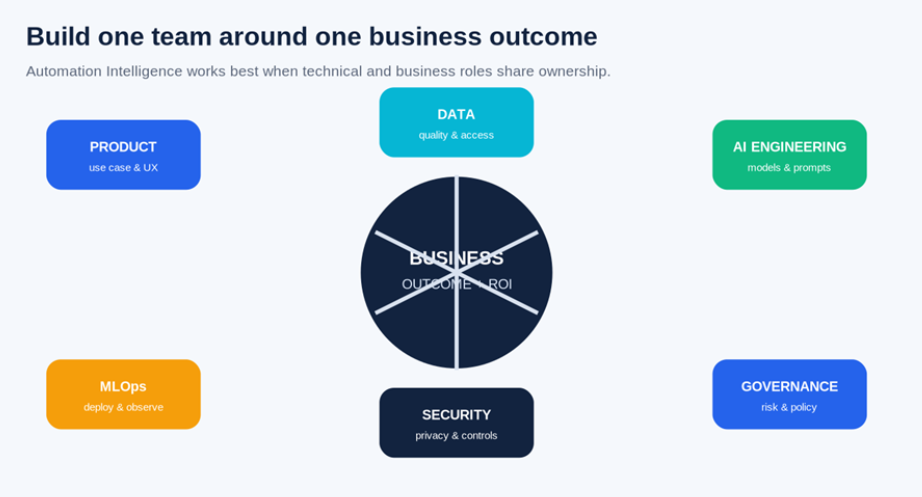
Cross-functional collaboration converts technical capability into business value. Business leaders define the outcome, product teams define the experience, engineers build the system, data teams validate information, security teams manage risk and operations teams support adoption.
McKinsey’s August 25, 2026 State of AI survey found that 44% of respondents reported AI scaling across their enterprise, up from 38% a year earlier. It also found that 40% of respondents from organizations with more than $1 billion in annual revenue reported scaling AI agents, up from 27% the prior year. [McKinsey, August 25, 2026]
8. ROI Measurement and Change Management
Every AI initiative needs a measurable business case and an adoption plan. Define the baseline process, expected improvement, quality threshold, operating cost and ownership before launch.
McKinsey’s 2026 survey reported that 32% of respondents said their organizations had decided against buying one or more software products or features because they could build them internally with agentic coding tools. That shift makes product judgment especially important: teams must know when to build, buy, integrate or automate. [McKinsey, August 25, 2026]
The Continuous AI Delivery Loop
Production GenAI follows a continuous lifecycle of problem definition, data, model and prompt design, evaluation, deployment and monitoring.
Which Skills Matter Most? A Practical Comparison
| Capability | Primary responsibility | Business impact | Adjacent expertise |
| Data engineering | Reliable pipelines, lineage and access | Better grounding and fewer data failures | Data analytics consulting services |
| AI engineering | Models, retrieval, tools and application logic | Useful, context-aware AI features | Predictive analytics services |
| MLOps / LLMOps | Evaluation, release and monitoring | Stable production performance | Observability and QA |
| Infrastructure | Cloud, APIs, compute, security and cost | Scalability and predictable operations | Cloud architecture |
| Governance | Privacy, risk, policy and oversight | Trust and compliance | Data security and compliance consulting |
| Automation design | Process mapping and orchestration | Less manual work and faster execution | RPA implementation services |
| Product & business | Use cases, adoption and ROI | Measurable value | Workflow automation services |
What the 2026 Data Says About AI Team Readiness
The evidence points to a capability gap, not simply a technology gap. Organizations are increasing investment while many still struggle to scale AI across business units. That makes governance, process design, evaluation, cost management and cross-functional delivery as important as model expertise.
How to Build the Right Team Without Hiring Every Skill In-House
You do not need every specialist on payroll from day one; you need the right capabilities available at each project stage. Keep business ownership and product decisions close to the organization while supplementing specialist skills where internal capacity is limited.
An early Automation Intelligence initiative may need process discovery and data assessment first, followed by AI engineering, integration and evaluation. As the system approaches production, MLOps, security, governance and monitoring become more important. This staged model can support businesses exploring RPA implementation services, CRM automation services, ERP automation services or predictive insights software without prematurely committing to a large internal team.
How ZAPTA Technologies Can Fill the AI and Automation Skill Gap
ZAPTA Technologies combines software engineering, AI/ML, product and delivery capabilities to help businesses move from AI concepts to usable systems. ZAPTA’s current service portfolio includes AI/ML applications, LLM applications, chatbot development and integration, data model training, computer vision, NLP and custom AI solutions.
- Build a technical foundation designed for secure scaling.
- Connect AI capabilities to existing business applications and workflows.
- Support automation across CRM, ERP and other enterprise processes.
- Establish evaluation and monitoring practices before production rollout.
- Strengthen governance, security and documentation as the system matures.
- Help internal teams develop the skills and operating model required to manage AI confidently.
Methodology: How This 2026 Guide Was Verified
This article was updated using current 2026 primary and high-authority sources. Statistics were checked against Gartner forecasts and survey findings published in 2026 and McKinsey’s August 2026 State of AI survey. Regulatory context was checked against European Commission materials. ZAPTA-specific service claims were checked against ZAPTA’s current website pages. Numerical claims are attributed to the source in the article.
Frequently Asked Questions
What is Automation Intelligence?
Automation Intelligence combines intelligent AI capabilities with business-process automation to improve decisions, workflows and operational execution. It can include AI agents, predictive analytics, RPA, integrations and AI-enabled applications.
What are the most important skills for a Generative AI project team?
The core skills are data engineering, AI engineering, prompt and context design, MLOps/LLMOps, cloud infrastructure, security and governance, process automation, product management and cross-functional communication.
Is prompt engineering still important in 2026?
Yes, but prompt engineering is now part of a broader AI engineering discipline. Teams also need retrieval, tool use, structured outputs, evaluation, model selection and domain knowledge.
Why does MLOps matter for Generative AI?
MLOps and LLMOps make AI systems maintainable after launch. They provide processes for evaluation, deployment, monitoring, versioning, incident response and controlled updates.
How does AI governance reduce project risk?
Governance reduces risk by defining how data, models and AI outputs may be used and controlled. It can cover privacy, access, human oversight, testing, documentation, vendor management and regulatory obligations.
Should a business build an internal AI team or use an external partner?
The right choice depends on required capabilities, project maturity and the long-term operating model. Many organizations keep business ownership internally while using specialists for architecture, AI engineering, integration, MLOps or governance.
How can businesses connect Generative AI with existing automation?
Businesses can connect GenAI through APIs, workflow orchestration, RPA, CRM/ERP integrations, retrieval systems and controlled AI agents. The architecture should begin with the process and security requirements rather than choosing a model first.
Final Thoughts
The teams that win with Generative AI in 2026 will not simply be the teams with access to the newest models; they will be the teams that can operate AI responsibly inside real business processes. Data quality, AI engineering, MLOps, infrastructure, governance, automation design, product thinking and collaboration form the practical foundation for Automation Intelligence.
With AI investment accelerating and enterprise scaling still uneven, the opportunity is to build deliberately: choose high-value workflows, establish reliable data, evaluate continuously, control risk and measure business outcomes. Whether your goal is intelligent automation consulting, workflow automation services, predictive analytics or a custom GenAI application, the right team structure can turn experimentation into durable capability.
Turn AI capability into measureable automation.
Avg. response · 24h
Pros
- Fast Deployement
- lower upfront engineering
- lower infrastructure burden
Cons
- provider dependencies
- less control
- usage costs at scale