




Future-proof your business! Learn how predictive analytics helps you turn data into proactive decisions, anticipate market shifts, and optimize resources.
Drowning in data but still guessing your next move? You’re watching opportunities walk out of the door.
Predictive analytics may sound like a buzzword, though it’s the difference between reacting to problems and staying ten steps ahead of them.
In this article, we explain how you can use predictive analytics and make the most out of your data to future proof your business decisions.
Predictive Analytics in Business: Turning Data into Future-Proof Decisions
Let’s begin with the basics;
What is Predictive Analytics?
In predictive analytics, we use historical data, statistical algorithms, and machine learning techniques to foresee future outcomes and trends in business. We take data as our guide and help companies anticipate their customer’s behaviour, market shifts or operational risks before they happen.
This shouldn’t be confused with descriptive analytics (explains what has already happened) and prescriptive analytics (recommends what actions to take). Because predictive analytics is all about what is going to happen next. It bridges the gap between past performance and future decisions aiming businesses with the foresight to stay ahead from the rest.
Real-world Applications of Predictive Analytics for Strategic Growth
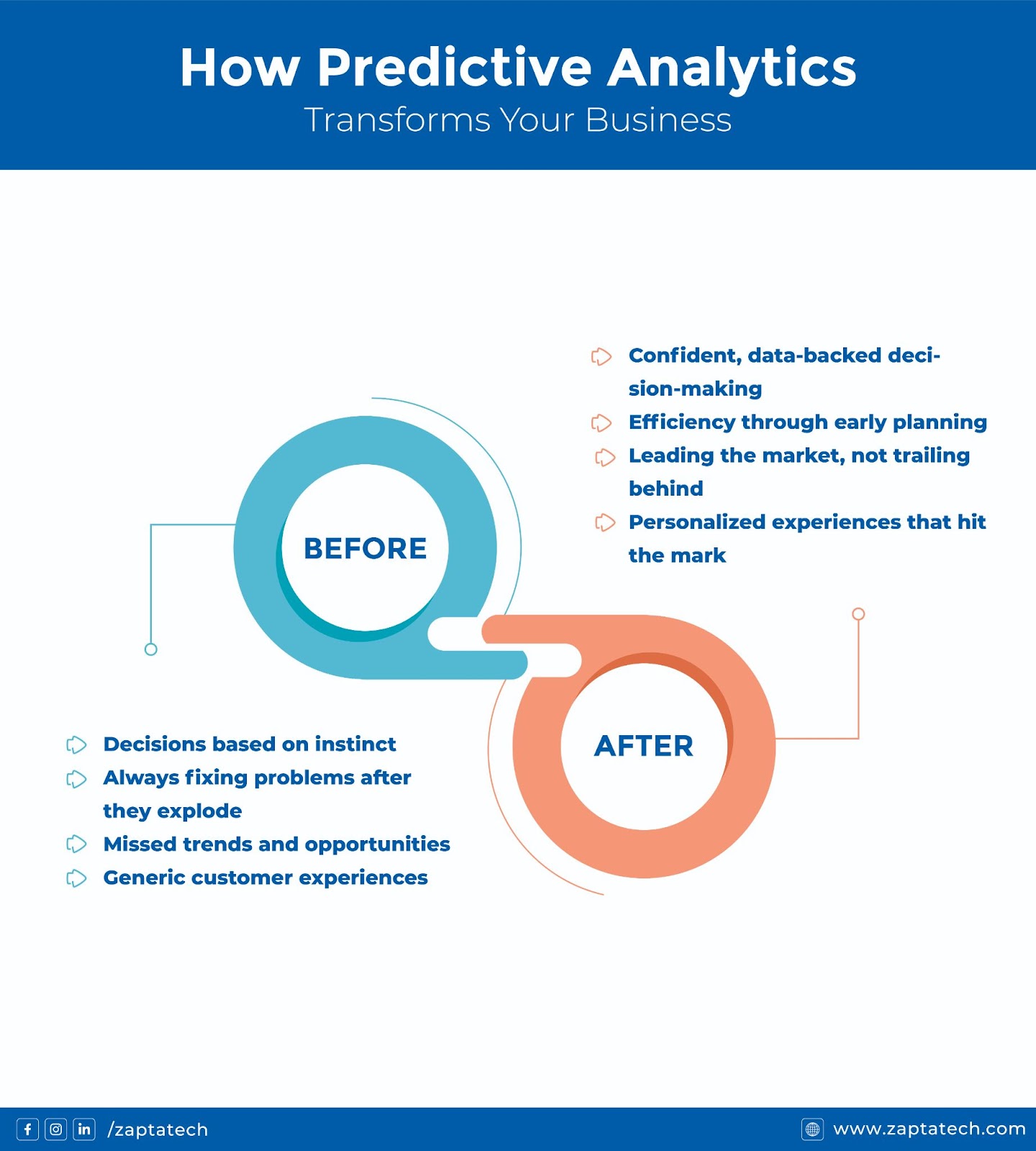
Predictive analytics is transforming how you operate your business day to day. By applying it to real-world scenarios, you can make smarter, faster, and more confident decisions.
This is how it plays out in practical terms;
Sales forecasting: being a product based business, staying ahead of the demand is always on your mind. With predictive analytics, you can plan with confidence by identifying trends before they happen. Let’s say you’re a retail brand and preparing for the holiday season. You can use past sales data and shopping behaviours to forecast which products will be in high demand. Now, you can adjust your inventory levels, avoid stockouts, and maximize revenue.
Customer behaviour prediction: understanding how and why customers engage or disengage is key to building long-term loyalty. Predictive models analyze usage patterns, transaction history, and interaction points to spot signals of churn or increased interest. A subscription-based business, for example, can identify users who might be on the verge of cancelling and intervene with personalized offers to keep them engaged.
Risk management: running a business means never going a day without facing a challenge or unknown risks. You can be dealing with financial fraud, operational disruption or more. However, with predictive analytics you can develop an early warning system that detects patterns of potential issues for your business. Think of a bank monitoring credit card transactions. If certain behaviour deviates from the norm, the system flags it as suspicious so you can take swift action before any real damage is done.
Resource allocation: you need plenty of resources to run your business efficiently without fail. Managing resources such as staffing, inventory, or logistics can be a constant challenge. Predictive analytics make it easier by helping you anticipate needs before they arise. For example, a delivery company can use traffic data and historical delivery times to optimize routes and allocate drivers more efficiently. This way you not only cut your costs but also improve on time performance.
Predictive analytics makes data useful and empower you to make better business decisions. It gives the clarity and confidence to run your business while turning what’s uncertain into a growth opportunity.
Implementation Challenges of Predictive Analytics in Business
Implementing predictive analytics in your business does give you benefits, but it also comes with its fair share of challenges. Below are some key obstacles that you may face when attempting to leverage predictive analytics effectively;
Data silos or poor data quality
Analytics are built on data, and it’s crucial to have good-quality data. Having data silos or poor data quality is one of the biggest challenges you may come across while implementing predictive analytics. Businesses often collect data from multiple sources and various departments. If the data is not integrated or of high quality, it can lead to inaccurate predictions and unreliable results.
Data silos occur when different departments store their data independently without sharing it, which hampers their ability to gain a holistic view of the business. It’s essential to have consistent data quality and eliminate silos to build effective prediction models that can drive accurate business decisions.
Need for skilled data analysts and robust infrastructure
You can have all the data in this world but not having the right team, tools or infrastructure to analyse the data, can waste its potential. You must invest in both human expertise and technology to properly implement predictive models. Skilled data scientists or analysts will help you clean, prepare and analyze large datasets as well as to build and interpret predictive models. Besides, a strong technological infrastructure is essential to handle the complexity of big data and support continuous analysis. Without the right combination of human resources and technological capabilities, businesses may struggle to make full use of their predictive analytics tools.
Over-reliance on models without human judgment
Predictive analytic models are powerful tools, but they are not infallible. An over reliance on these models without the input of human judgment can lead to decisions that are out of sync with real world nuances. See models can identify patterns and predict outcomes; they can’t be compared to human insight needed to account for variables that were missed in the data. So, it’s important for businesses to balance the use of predictive models with human intuition and expertise. This will make your decisions both data-backed and contextually relevant.
Bias and Models Drift Over Time
Lastly, predictive models can suffer from bias and drift over time. Bias can be introduced if you train your models on data that is not representative of the population or if you overemphasize certain variables. Additionally, as new trends and changes emerge in behaviour, it can affect the accuracy of your model causing what we call “model drift”. However, this can be avoided if you regularly test and update your models against current data.
Predictive analytics offers significant potential for businesses; however, navigating this technology requires a strategic approach. To truly make the most out of predictive analytics, you need a technology partner like ZAPTA Technologies AI custom software development company that combines the power of human technical expertise, deep business insights, and the ability to leverage AI models.
Our team understands the real challenges companies face and knows how to turn raw data into meaningful and actionable strategies. With ZAPTA Technologies AI software development solutions support, you don’t just get predictive models, you get tailored solutions built by people who know the game, anticipate the pitfalls, and deliver results that actually move the needle.